I Have Been Called Out, and I Deserve It.

In the last blog post I said that if I needed to be called out, please do so.  Well, I have been.  Graeme is a good friend that I met in Grad School.  He is a guys guy.  One who shaves with a straight razor (the thought still scares me) and one day decided to bike home… to Winnipeg… from Calgary… by going to Banff, then Jasper and then to Winnipeg.  The friends I met in grad school are guys I hope to keep in touch with for the rest of my life.  We were in the “trenches” together (actually, office KNES 131) and we went to “war” together (actually KNES 673, 773 and 775).  I respect all their opinions very highly.  This is the email I received from him this afternoon.

Hey Buddy,

Having somewhat settled down for the time, I’ve caught up on your blogging. I’m enjoying the posts…but you seem pretty jaded of late! Whats going on?? Is everything OK?!? Did Kelly send back long-lost lab reports??? Maybe it seems like a bigger shift b/c I’m reading months of posts at one go, but the focus of your blog seems to have shifted dramatically – from one that sought to educate others in topics that were valid but others might not touch on…to one that seems like a outlet of frustration that is filled with condescension and self-promotion. Sorry, but there is so much ego and criticism in our field already; one of the things I really enjoyed with your posts was the honest feeling, and desire to educate. It was refreshing, and it’s a little disappointing to see that lost recently.

Anyways, that’s just an overall impression I had during my last reading, but really I feel like commenting and getting your views on something that was stimulated by a post back in January.  It was RVAs statement “To me it is bad practice to recommend something or say something is better with no evidence/justification to support the claim.” combined with your ‘need’ to provide posts in support of raw milk to remain credible, which seemed to equate ‘being credible’ with ‘engaging in good practice’. This stimulated my own thoughts on precisely what makes ‘good practice’, which is a lengthy and un-completable task, so I’ll limit myself to the 2 points brought up by the post.

1) The equivocation of credibility to ‘good practice’. I found it particularly difficult to delineate my thoughts on this, because there were some semantics to work through first. The definition of ‘credible’ is that which is worthy of confidence. It is a quality that one possesses. Good practice entails a set of actions that one engages in. They cannot be equated. However, I believe the actions that lead to credibility include possessing extensive knowledge of his field, remaining within your scope of knowledge/experience, and qualifying positions/actions rationally. I believe these actions are a prerequisite to be engaged in good practice, but in of themselves are not enough to fully satisfy ‘good practice’.

2) The role of science in ‘good practice’.  “To me it is bad practice to recommend something or say something is better with no evidence/justification to support the claim.”  At first, I thought this equated to “good practitioners should recommend only that which has scientific evidence behind it”, but the word ‘justification’ is very important to RVAs statement. So important, that I wish it was emphasized, b/c it was too easy to gloss over it and walk away with my initial interpretation!

However, I believe this statement is still misleading, as it seems to relegate the role of science in ‘good practice’ to ‘scientific evidence’. I believe that to limit oneself only to scientific evidence behind it would actually be bad practice! There are too many limitations of the scientific method in providing meaningful evidence of change in athletic / exercise performance as a result of an intervention; inadequacy of ‘statistical significance’ in demonstrating meaningful changes due to individual training responses and protocol variability (i.e. the Will Hopkins argument for ‘magnitude-based inferences’); the rigor of conducting and publishing research causing science to lag behind leading-edge practice, the presence of equivocal research on most topics, the non-published research of successful coaches and sporting centers…etc.

I think the key element here is that good practice entails application of the entire scientific method to relevant training situations and decisions, even when ‘scientific evidence’ is lacking. That is, knowledge of the relevant basic science, critical analysis and interpretation of available research, development of a well-supported hypothesis, and systematic testing / monitoring throughout the intervention (‘training’). 


I would like to thank Graeme for calling me out.  And the same thanks goes out to Ryan (RVA) as he called me out a few months back.  I was in need of this wake up call.  I will admit, I have been jaded, I have not been myself lately.  I have felt lost, distracted and frustrated.  It was not that long ago I was talking to Pam about leaving it all behind.  But there is nothing in this world I would want to do more as a career.  I love my job, I love the clients I work with and I love the opportunities it has brought me and I love writing on this blog site.  I started to aim to educate on the importance of certified and educated professionals but that quickly turned in to a “mission” to clean up the profession.  Instead of leading by example I started whining and complaining on my blog and I started inflating my own ego.  Then Graeme, seeing this shift (he has been biking across New Zealand and Australia with limited internet access) gave me the kick in the ass I needed.  He’s right; I have been no better than anyone I have been lobbying against.  I have been standing on my soapbox bitching and complaining instead of leading by good practice and educating as I first intended and thus separating myself from the ones I have been so frustrated by.

But this week of meeting was something I needed too.   I recently had a client tell me, “Your brain does not work like everyone else’s.   Your brain is running 90 times faster than most.  You have a lot of information in that head of yours but you are unfocused.  You need to take that information and focus it.  That is going to lead you to success.”  It is important for me to rediscover the fact that I needed to focus on what I have been doing that has lead to the successes I have achieved.   I have “forgotten” some of the practices that have placed me in the position I am in in my career.  That is why I am going to be doing a book club with a dear friend of mine, Amber, whom I did Holistic Life Coach 1 and 2.  I have left that on the shelf for a bit, but she has given me the push to get back to that.   I need these wake up calls from friends like Graeme and Ryan, guys who I respect.

I am sorry to all my readers for the negative tone to the last three posts, the condescension and self-promotion.  It is not a quality that I admire, nor something that I would like to exude.  I promise to carry myself in a more professional and educational manner.   I would like to thank you all for following this blog and I hope to better serve you from now on.

Yours in Health and Performance,

Jeff Osadec, MKin, CEP, CSCS

 

Opinions are like… Well you know. Everyone is an Expert.

Last week, I slowly packed my office.  Placed all my books in a box, along with all my belongings of my desk and filing cabinet.  It was a strange feeling.  Knowing that I would not be coming to the same place.  No, I did not quit my job.  We are in the middle of a renovation (painting, cleaning and reorganizing).  It is going to be nice to come back to a “new” gym.  However, with renovations comes the subsequent displacement of our staff.  And that lead to a productive three days in a boardroom discussing the direction of our company, our roles and our responsibilities.  Much of that discussion was based on who we are as a company and who we are as coaches.  We as a company have made a major policy as well.  We will be mindful of what others are doing, but under no circumstances will we be concerned with other “competitors”.  It brings about too many distractions and negative energy towards the goal we are doing as a company.  We need to put that focus on what we are doing.

I have been reading Men’s Health for quite some time and I would say that David Zinczenko as editor has been one of the best things to happen to the magazine.  The last editorial this past month rang so true to the message of this post.  There are a lot of so-called “experts” out there.  With the Internet, everyone can set up a site and post their opinion and call it law or fact, and that includes me.  However, what is not evident is the level of expertise and knowledge that these experts possess.  Many lack the practical experience, clients or theoretical knowledge to back up their claims. Many of these experts work in “packs”.  What I mean is, they are friends with others who are writing on the Internet, and they are all promoting each other.  They scratch each other’s backs.  But that is the times in which we live.   The Internet has created over night experts.   Not only are these experts sharing their information via email, some of them have begun to create courses and certifications based on their ideas.  And they then foster a new group of followers spewing the views of the so-called expert.  It is a vicious cycle, and I guess you could say it is almost cult like.

And a lot of people follow what these experts are posting.  I have been guilty of that when I first started in the profession.  I read everything that others wrote and took it for fact.  However, I was so naïve that I did not take a critical look at the information.  However, with the completion of grad school, I have become more critical of the information I read.  And that is the message of this post.  To be critical of the information that is out there, the information on the Internet, and the information that is shared by these so call experts.  Look at the information that is being presented and look at what others are saying about it, not everyone will share the same view.  That critical look at the information includes the information from this “expert”, me.  If I begin to spew BS I want you to call me on it.  If I become a self-promoting asshole, email or comment and say, “Hey, you’re becoming a dick.” That will force me to be credible in the information that I relay on to all of you.  And one of the goals I have always maintained is to not become one of the self-promoting “experts” out there.  Because who am I kidding.  As one of my friends put it, “I am just above nobody status in the grand scheme of things.

Yours in Health and Performance,

Jeff Osadec, MKin, CEP, CSCS and emerging expert.

I AM AN APPLIED PHYSIOLOGIST

My aim has alway been not to offend anyone but today I am just fired right up

I will elaborate more in a upcoming post…

As a friend of my said… this sums it up!

Hey,
I’m not a fitness attendant, or a fitness instructor,
and I don’t compete in competitions where “six pack” matters,
or  load up on supplements from Popeye’s or GNC.
I don’t own any gadgets from late night infomercials,
And I don’t care what the trainer did on the Biggest Loser,
although I’m certain got impressive results.

I have a degree or two (actually 4 = 11 years of school) … not a weekend course,
I speak in scientific terms and make it understandable, not in acronyms
and I don’t care what someone wrote on T-Nation.

I can proudly tell you everything that impacts VO₂ max,
I believe in whole movements and not isolation,
innovation and application,
and that my programs are periodized and have purpose.

A Kettlebell is a tool,
I read journals for my information, not the internet or Shape.
High intensity exercise is hard on the central nervous system,
and it CANNOT be done every day!
Many of us have put in numerous years,
a lot of time and effort,
and are proud of what we do.

My name is Jeff…
and…I……AM…… APPLIED PHYSIOLOGIST!

NOT A PERSONAL TRAINER

Thank you.

For $1000 Alex! Gorillas and Running Marathons…

What is the next special on Fox?  A few years ago they had on “Man versus Beast”.  A terrible show where they pitted animals versus humans in athlete or strength based feats.  They had a race between an elephant and its equivalent weight in “little people” pull a cargo plane a specific distance.  Funny, I would rather watch that then “The Bachelor”.   I wish they would have had a Gorilla squatting or bench pressing, I would be curious to see how much they can bench.  I have also thought of testing the VO₂ of squirrels, but we would need really small Douglas bags (lame ex phys joke).

You don’t see gorillas running long slow distance, and you do not see a jacked up squirrel.

What I am getting at is the idea behind concurrent training.  According to Levitte et al. (1999), “Athletes involved in many sports often perform strength and endurance training concurrently in an effort to achieve adaptations specific to both forms of training.  To date, research investigating the neuromuscular adaptations and performance improvements associated with concurrent strength and endurance training (subsequently referred to as concurrent training) has produced inconsistent results. Some studies have shown that concurrent training inhibits the development of strength and power but does not affect the development of aerobic fitness when compared with either mode of training alone.  Other studies have shown that concurrent training has no inhibitory effect on the development of strength or endurance.  However, it has also been shown that the development of aerobic fitness is compromised by concurrent training.”

So I am not going to say that I am an endurance guru.  There are many people in Calgary who are great at it.  Jack VanDyk of Endurance Training Systems at the Talisman Centre is one of those guys.  My buddy and fellow classmates, Mike Patton and John Sasso are also guys I would trust with an athlete for endurance training.  I could take a non competitive client and train them for their first marathon or distance bike ride, bloody hell; I am doing that for myself.  I will hang my hat on the fact that I can test these athletes and analyze the test with some of the best around.  But I have a lot of work to do if I ever decided to take on a competitive endurance athlete.  My job, my specialty is getting athletes stable, strong and powerful.  In some cased one, two or all three of those for an individual athlete.   And here is where things disconnect.

I spent the summer as the assistant strength coach for the Canadian Cross Country Ski Team.  I loved the job, the staff and the athletes.  I hope that I can renew it again for another year.  This team is full of aerobic machines.  I would love to have half the fitness of any of them. Now would I look at making an athlete of that fitness caliber bulky by training for strength?  I have written programs for a friend of mine who is now on the National Triathlon team.  I would not go and try to get him “jacked”.   The biggest fear of any endurance athlete is a decrease in performance and from the literature there is that possibility that strength training will decrease performance… if the strength coach does not know what he/ she is doing.

This is the way I look at it.  Strength training for an endurance athlete is absolutely necessary, but it is not about size.  It is about stabilization, building a structural tolerance to with stand the event that they are competing in.  My job in developing a strength training program for an endurance athlete is based around developing strength in the associated joints so that that athlete can develop optimal power and transfer that into the ground (for upright athletes) or pedals (for seated athletes) as a simplistic example.  Therefore that transfer of power leads to a greater ground reaction force and ease of propelling themselves forward at a greater speed.  Couple that with the appropriate cardiovascular training and you have an athlete who can run or cycle at a great percentage of their VO₂ max with great efficiency.

General clients and weekend warriors, guess what?  Concurrent training is not going to decrease your performance.  You are not a specialist, you are a generalist.  A well rounded fitness program for a majority of the population as discussed in my last post includes mobility work, resistance work, endurance exercise and rest/ recovery/ regeneration.

Once again, yours in health and performance,

Jeff Osadec, MKin CEP CSCS

References

Applied physiology of marathon running. B Sjoedin, J Svedenhag Sports Medicine 2:22, 83-99, 1985

Factors affecting running economy in trained distance runners – Saunders

Running economy of elite male and elite female athletes – Daniels

Concurrent Strength and Endurance Training (Leveritt SportMed 1999)

Incompatability of endurance and strength training modes of exercise

Strength and conditioning training for runners

Tabata bout The VO₂! (Yes a terrible pun)

As many of you know I am a Certified Exercise Physiologist (CEP) and with that come the subscriptions to research journals, and provincial fitness “informer” magazines.  For the most part the articles are great.  Many will delve into a watered down scientific background for the topic at hand and then a practical approach to utilizing it in the field.  However the past publication came in and I was browsing through it.  I will admit, I do not read every article unless the title catches my attention.  One article this past issue was discussing Metabolic Training.  You can guarantee this caught my attention.  The article for the most part was very well done, with a great background on the energy systems, the times that the systems are predominant for and then the characteristics of the muscle fibre types and the energy systems that they are most predominant.

However, at one point the article mentioned the article by Dr. Izumi Tabata called “Effects of moderate-intensity endurance and high-intensity intermittent training on anaerobic capacity and VO₂ max.”

Effects of moderate-intensity endurance and high-intensity intermittent training on anaerobic capacity and •VO2max

It has been made more popular by the Crossfit market, and this study created such a rage that now hundreds of thousands of trainees around the world now include “Tabatas” as part of their programming.  They utilize the time scheme of 20 seconds of work followed by 10 seconds of rest for 8 sets.  For an example, they may have an athlete do 20 seconds of squats, followed by 10 seconds of rest, for 8 entire sets, and then do another exercise after a predetermined rest period.

So, during the time of my Masters program I was required to attend a journal club where we would summarize a peer reviewed journal article and then critique it for the entire club.  A great discussion from the group would ensue.  As much as I would hate having to present, I am grateful for the ability now to read an article and make an educated critique of the material.  Many of you may see where this is going.  The article in the provincial magazine stated the proposed findings of the Tabata article which was with this protocol, a increase in VO₂ and an increase in anaerobic capacity.

But with the popularity of this protocol there are two major mistakes when it is utilized.  My goal is to clarify the article so that those of you who read this blog will not fall for the same pitch line of an increased VO₂ with only 8 minutes of work.  Note:  this may be where the gentleman from the fitness show got the idea that to increase VO₂ and train for aerobic events, you only need to do six minutes of work.

The biggest issue is that no one is doing the Tabata protocol.  Despite this systems popularity, the protocol has been bastardized to fit the understanding of those using it.  Although it is often cited, very few people have actually read the entire article, hence why I have a link to it above.  It was rather difficult to find a PDF version but I think if someone is going to use it, they must read and understand the methods and results before they can use and understand the adaptations that occur from its use.

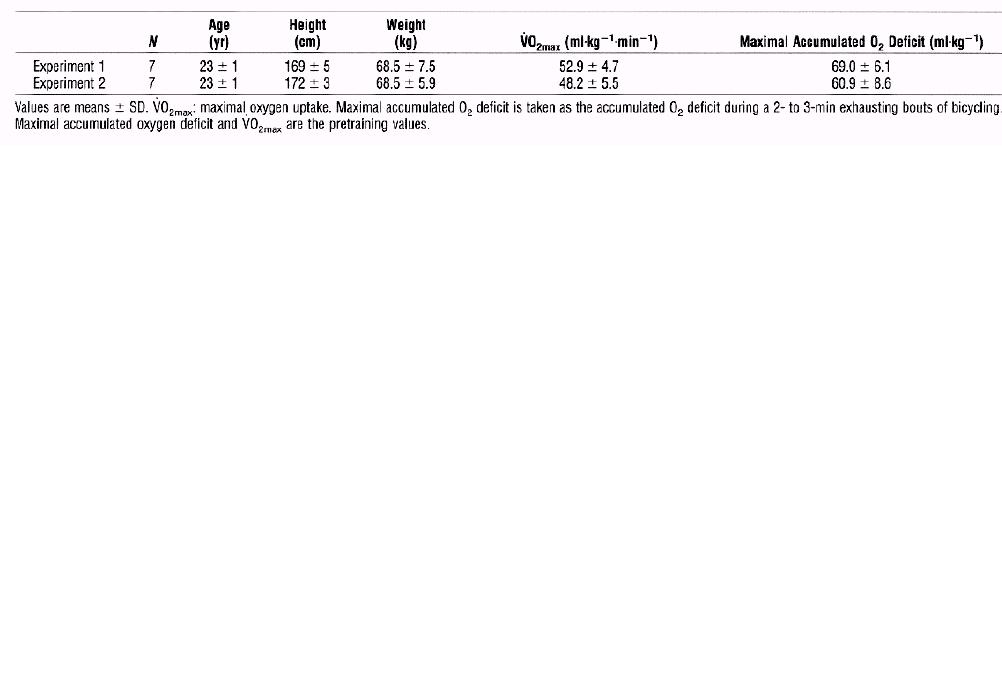
When reading through the methods, it will state that one group performed moderate intensity (70% VO2 Max) steady state cardiovascular exercise for one hour on 5 days per week. This would be Long Slow Distance (LSD) work.  The other group used the Tabata protocol which consisted of a 10 MINUTE STEADY STATE WARM UP followed by 7-8 sets of 20 seconds at 170% VO₂ Max on a mechanically braked cycle ergometer with 10 seconds of rest between each set…. Intensity Work.  The Tabata group performed this exact protocol 4 days of the week.  On the fifth day they performed 30 MINUTES OF STEADY STATE EXERCISE AT 70% VO2 MAX followed by 4 Tabata intervals (20 on 10 off).

So let’s recap… 10 minute steady state warm up x 4 = 40 minutes and add to that 30 minutes of steady state exercise at 70% VO2 max is a total of 70 minutes of LSD work!  And that is combined with the 4 x Tabata Protocol.

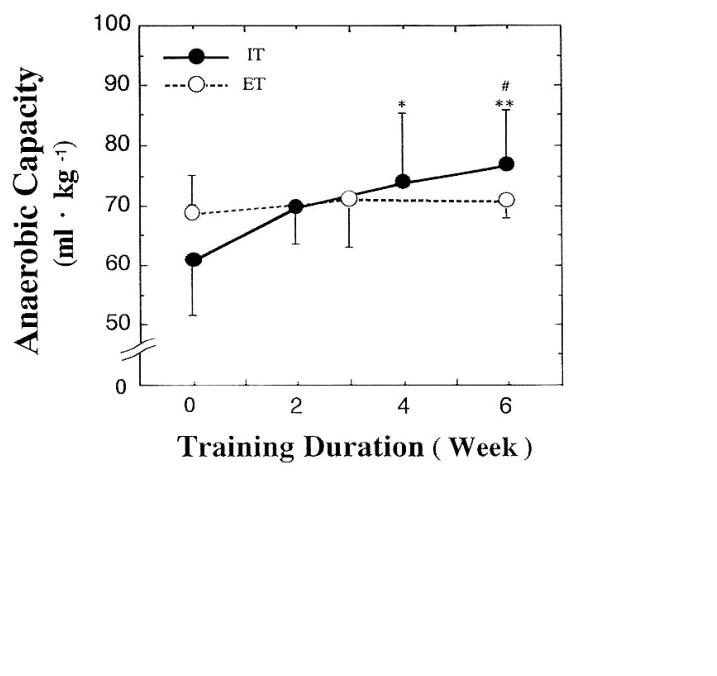
Tow glaring errors are present with using the Tabata Protocol in the mode that lets say a fitness class or group would use it.  One, you are not doing the Tabata Protocol.  It is not on a bike, nor would the intensity be in the 170% of VO₂ max required to be a true Tabata.  I would challenge that during a bout of un-weighted squats, for 20 seconds on and 10 seconds off, times 8 rounds, VO₂ would not get above 100%.  If someone has a study that could prove me wrong… please, I would appreciate you forwarding it to me for an evening read.  Two, by using the “Tabata Protocol” for body weight exercises or whatever a fitness class is doing, you may see an increase in anaerobic capacity, but I would suspect that you will not see an increase in VO₂.  Reason I say that is there is no LSD work associated.  Let me explain further.

The following diagram demonstrates the effects of training LSD and Intensity.  The Red blocks are primarily central adaptations (changes to the ability of the body to deliver blood, hence O₂… think heart) while the blue block are primarily peripheral adaptation (changed in the body’s ability to utilize the delivered O₂… think muscles).

To train only high intensity will develop the body’s ability to utilize O₂ but the engine (heart) will not perform adequate delivery.  Beautiful muscles with a weak heart.  That would be the equivalent of putting a Kia engine in a Ferrari!  Honestly looks good but still a piece of shit.  Now, for those who do only LSD work, they have the engine (heart to deliver) but no ability to adequately utilize the delivered O₂, so we can equate that to having a Ferrari engine in the frame of a Toyota Echo.  That engine would tear that frame a new one, no ability to perform.  That is why you need to train both LSD and high intensity.

And this is why the Tabata Protocol in the paper increased VO₂.  The Tabata group performed 70 minutes a week at LSD and high intensity work.  However there are some other things to consider with the paper.   The students were athletic males but the Tabata group stated with a lower Relative VO₂, therefore if we take into account the ceiling effect of training, with the ET group having a relative VO₂   of 52.9 +/- 4.7 ml·kg·min⁻¹ the amount of improvement could be minimal… if only doing LSD work.

But to look at the figures for VO₂ both groups improved but the Tabata Group (IT) had more room for improvement and they trained both LSD and high intensity.  And yes, anaerobic capacity did not improve in the ET group, but that would be expected with the type of training performed.

Let me make this clear.  I’m not against interval or intensity training.  High-intensity interval training and the Tabata protocol are only one tool in the toolbox.  Claiming that intervals can increase VO₂ and anaerobic capacity, when the protocol is incorrect is false advertising.  8 sets of 20 sec on and 10 sec off may be challenging but the Tabata protocol it is not since body-weight stuff or the other stuff that is often suggested simply cannot achieve the workload of 170% VO₂ max that this study used.  Use the “Tabata Protcols” for what they are… a hell of a workout, but if you are looking to increase VO₂ and anaerobic capacity using the true Tabata Protocol, I suggest getting some bike shams, because you are in for some long hours on the cycle trainer.


Once again, yours in Health and Performance,

Jeff Osadec, MKin, CEP, CSCS


The Basis of Modern Training Process

As many of you                have already figured out, I am a huge proponent of education both academic and professional upgrading.  I am very fond of the integration of the pure science and the holistic approaches, however in the past I have not provided enough evidence based articles to back up the claims that I have learned through some of the course work I have attended.  From now on I will aim to do just that, however the frequency of my posts may decrease as I aim to research the topics to a greater degree.

Another thing I am a total geek for is reading.  Funny, I hated it as a kid, and read only when I needed to complete a book report.  Magazines were more my thing, less time, and more than one long article.  However my love for reading came in University when I started to read what I was interested in, and peaked with the meeting of Andrew Gustafson.  I to this day admire the depth of Andrew’s knowledge and wide array of reading material.  When I worked with Andrew, I would go into his office and see what new books he had in his library.  Each week I went to work, my wife Pam was hoping that Andrew did not get any new books because she knew that the shift I worked would be spend at Chapters ordering new material.

I have just started a new book called “The Secrets of Soviet Strength Training by Dr. Michael Yessies.  The Secrets of Soviet Sports Fitness and Training, published in 1987, tells the story of Soviet sports success in the Olympic Games and World championships.  It describes the key factors of the Soviet system of training athletes — a system that is still unsurpassed by any country in the world — not even after the country was dismantled.  I purchased an updated version of the text.  In addition to the original, an addendum has been added to each chapter to bring it up to date with the advances that have been made since the first printing.  More information from practicing Russian coaches as well as from the literature has been included.  Also added are results from application of Russian methods by coaches who have incorporated one or more aspects of their system.

Reading the text, coupled with a conversation with a client and the fact that her son at 8years old plated 6 games in 7 nights though got me thinking back to an article that I read and summarized in graduate school.  It was called “The Basis of Modern Training Process Periodization in High Performance Athletes for Year Preparation” by Vladimir Platonov.  This article summarized the training a periodization of athletics, and our job in school was to summarize the “directions” into one or two sentences.   Although this is directed at national and professional athletes there is a great amount we can learn from this and translate to the training and periodization for youth and recreational athletes/ weekend warriors.

Below are the summarized directions that may help you as you read the article.

Platonov-2006-

Direction 1

The volume of training has increased 2 – 4 times since the 1960’ mainly due to the increase in commercial competitions.  This increase in training volumes had a negative impact on the success of the individuals and/ or teams performance.

Direction 2

Early specialization of children for the hopes of producing the elite athletes has been detrimental to long term athlete development.

Direction 3

The number of competitions in a given year has risen which does not allow the athlete to peak at the major competition.  They must perform at each competition to obtain points for standings.  This may decrease the perceived “importance” of the main competition (e.g. Olympics)

Direction 4

Periodization of the training for an athlete must be set in such a way that it accounts for the athlete at the final stages of their career.  This must include proper rest and health practices. Too long are athletes left “broken” at the end of a career. I will admit, I will try and train my final year veterans at the college for life after their given sport.

Direction 5

Early specialization has lead to a decrease in the general training that develops the structural tolerance of young athletes that improves their capabilities at later stages in their career.

Direction 6

Early specialization has changed the methods in which athletes are chosen for competitive teams/ events therefore changing the direction in which coaches have trained the athletes in the past.

Direction 7

The functional training for an athlete should be foreground to specialized training to ensure proper long term athlete development.   However, my definition of functional is “It is the development of adaptive responses to an endurance or resistance stimulus and the ability to translate those responses in a physical response so that the body can move in synergy and produce a purposeful movement.”

Direction 8

The lack of fundamental training that is compromised for specialized training leads to an over reaching or fatigue response. Athletes are training too hard and too often to recover.  I am going to point a finger at the constant high intensity training that is far too common in the profession today.

Direction 9

Training must be periodized in such a way that it balances the work to rest ratio.  Training must include…

Mobility and Movement Preparation, Pre-habilitation/Corrective Exercise, Elasticity, Core Training, Strength Training, Metabolic Training and Regeneration

Direction 10

Planning and scheduling of competitions must be in a timely and logical order to ensure performance is peak and necessary adaptations take place prior to the event.

Direction 11

The coach/ physiologist must have a large “tool box” from which they can plan appropriate training.

Direction 12

Education and planning of proper progressions, fundamental movement patterns and regenerative techniques for the athlete is highly important in the prevention of injuries.

Direction 13

The methods of training and periodization for athletes of any age must be flexible as to be tailored to the needs of the athlete.  Planning and periodization is not a ridged method.


The article by Platonov did a fantastic job of bringing to light some of the glaring issues that occur in many programs that are written for clients, athlete and the general public.  Hopefully, this for a more careful view of your program to ensure that you are not falling into the directions pointed out in the article.  I am now going to spend a bit of time researching some concurrent training articles, looking at the purpose of combining strength training and endurance training, as I believe that the perceived purpose of strength training for endurance athletes is not well understood.

Cheer and once again, your’s in Health and Performance,

Jeff Osadec, MKin CEP CSCS


And Sometimes I Just Have To Sit Back And Laugh.

It was a great weekend at the Ultimate Health and Fitness Show.  Although the weather did not cooperate there was still a great turn out.  As well, it was fun to meet many different people and answer numerous questions.  As many of you would know, I love educating people and this weekend was a great opportunity to do just that.  However when we go to trade shows a couple of things happen.  One, we get to connect with some amazing people.  I was able to meet a chiropractic group that I am going to meet with, in a week or so.  Dr. Karen Quinn has an interesting philosophy and is very knowledgeable.  Two, we get to see what some of the “snake oils” that are being promoted.  We all would like a quick answer to fitness but a cold laser that increases the mitochondria’s ability to generate ATP… I would need to see some peer reviewed articles on that one.  Down the aisle from that booth was the guy selling the Shake Weight, a group demonstrating the pole dancing classes, and someone with the vibration platforms.  So here I am thinking, if I can get one of those vibration platforms into the base of the pole, and toss in a couple of shake weights… let’s just leave that thought alone right now.

Anyways, at this particular show there were stage presentations.   Now Peak Power was a presenter, as were many of the exhibitors.  However, the egos in the profession never cease to amaze me.  One of the presenters said that “Power is using gravity to your advantage!”  WHAT?  Mechanical Power is often defined as work that is equal to the force acting on an object times its displacement (how far the object moves while the force acts on it) where the force is the mass x acceleration.  You must produce a force to overcome gravitational effects.  I got a chuckle out of that one.   But the day was young.  Near the end of the day we were all tired, ready to call it an end and one of the last few speakers were about to go.  In between talking to the last few people who where around we were able to hear this gentleman speak.  Three comments in particular from the presentation have had me laughing for the last three days.

Comment 1: “The text books are wrong.” Really, they are wrong?  Yes new research may at some point in the future change our understanding and perceptions but the text books are not wrong.  Thousands of Universities would not have students purchase them in order to teach incorrect information.  More so, these texts challenge your understanding of the training of science and since they do not conform to his method of teaching and explanation, they must surely be wrong.  Tell that to McArdle, Katch and Katch.  They would bludgeon him with the very text book they wrote.

Comment 2: “It is all about training the ATP-CP system not the aerobic system.  If that system is not trained and you do something that is explosive (using the ATP-CP system) you could have a heart attack.”  Seriously?  The ATP-CP system utilizes immediate energy supply provided almost exclusively from the intramuscular high-energy phosphates, or phosphagens, adenosine triphosphate (ATP) and phosphocreatine (PCr).  It would allow one to walk briskly for 1 minute, run at marathon pace for 20 to 30 seconds, or sprint run for 5 to 8 seconds.  This information was taken from McArdle, Katch and Katch’s text book, “Exercise Physiology – Energy, Nutrition and Human Performance.” I am personally convinced that just because you do not train the ATP – CP system, this is not the sole reason one would have a heart attack, I would suspect there will be many other factors that would have to play a role.  But since I took the information from a text book, according to this person’s first comment, the information is wrong.

But the final Comment 3 was my favourite.  To this very moment, I cannot understand how someone could stand in front of a group of people, peers, and other professionals and say these very words… “I am very excited to be here at the Ultimate Health and Fitness Show.  This show is the second best thing to happen to the Calgary fitness industry since the opening of [his facility name here].”   That very comment, with its arrogance was so utterly egotistical that I actually threw my hands in the air.   If this would have been at a conference, he would have been booed off the stage.   If there would have been more of the strength and conditioning community there, I can think of one person right now who would have gotten up on stage and literally fought him.  I am still floored.  I told my boss if that would have been him, and he said that I would quit on the spot.  There are people in this city who have forgotten more than I know.  There are people doing things out there trump the opening of his facility.  I am still just in shock that I was there to hear that.  But I am glad to have been there to hear it, because if I ever get to the point where I would say something like that, I want one of you, my readers to call me on it, and I will quit this profession immediately.  I would never want to be in the same category as him.  What little credibility this guy had in my mind is now erased.  He may as well be on a late night infomercial selling shake weights.

But with the long explanation of a very interesting weekend, I come to the point of the post… credibility.  This was brought to my attention by a good friend and colleague of mine, Ryan Van Asten.  He is an extremely smart guy with a great blog as well (you can find it in my links section).  He is very much based in the science, and it must be proven by research.  We have been debating a previous post that I talked about Raw Milk.  He stated, “To me it is bad practice to recommend something or say something is better with no evidence/justification to support the claim. Do you agree with that?”  I do agree with that, and I realized that although there are 100’s of articles that are against Raw Milk, to post the benefits of Raw Milk, and to remain credible I need to find articles that are in support of  Raw Milk.  As I told Ryan, my aim of the post are not to tell everyone what they need to do, but rather give them the resources to make an educated decision.

So here I present a list of references so that an educated decision can be made.  Now once again, I am not telling people to go out and seek Raw Milk, I am merely providing the second side to a story.  Some of these references show the risks of raw milk, as well as the benefits.  And thank you Ryan, for calling me out and keeping me on my toes.

Cow’s Milk Allergy A Complex Disorder

Effects of Processing on Pesticide Residues in Milk

Massive Outbreak of Antimicrobial-Resistant Salmonellosis Traced to Pasteurized Milk

Crewe, J. R. (1929, January). “Raw Milk Cures Many Diseases”. Certified Milk Magazine, pp.3-6.

Darlington, J. B. (1947, March 15). “Why MIlk Pasteurization, Part 1: Sowing the Seeds of Fear”. The Rural New Yorker,

Darlington, J. B. (1947, May 3). “Why Milk Pasteurization, Part II: Plowing Under the Truth.” The Rural New Yorker, P. 4-5.

“EU Scientific Committee Warns of Human Health & Caner Hazards of Monsanto’s Recombinant Bovine Growth Hormone (rGBGH)”. (1999, March 15-16). Scientific Committee of European Union of Veterinary Measures Relating to Public Health Outcome”.

Ferrer, F. P., & Boyd, L. J. (1955, September). “Effect of Yogurt with Prune Whip on Constipation”. “American Journal of Digestive Diseases”, Vol.22(9), pp.272-273.

Frost, W. D. (1929, January). “Some Bacteriological Problems of Milk Control”. Certified Milk Magazine, pp.6-10.

Harrison, G. (1975, ). “Primary Adult Lactase Deficiency; A Problem in Anthropological Genetics”. American Anthropologist, Vol.77, pp.812-835.

Kretchmer, N. (1972, ). “Lactose and Lactase”. Scientific American Journal, Vol.227, pp.70-78.

Pottenger, F. M. (1938, July). “Clinical Evidences of the Value of Raw Milk”. Certified Milk Magazine, Vol.3, pp.17-22.

Ryan, C. A. (1987, ). “Massive Outbreak of Antimicrobial-Resistant Salmonellosis Traced to Pasteurized Milk”. Journal of the American Medical Association, Vol.258, pp.3269.

Schmid, Ronald. (2003). “The Untold story of milk.” New Trends Pub Inc.

Thomson, J. C. (1943, ). “Pasteurized Milk, A National Menace: A Plea for Cleanliness”. The Kingston Chronicle, Edinburgh, Scotland,

Woodford, K. (2007). “Devil in the milk.” Chelsea Green Pub Co.


2010 in review – Thank you to all my readers

The stats helper monkeys at WordPress.com mulled over how this blog did in 2010, and here’s a high level summary of its overall blog health:

Healthy blog!

The Blog-Health-o-Meter™ reads Fresher than ever.

Crunchy numbers

Featured image

A Boeing 747-400 passenger jet can hold 416 passengers. This blog was viewed about 2,600 times in 2010. That’s about 6 full 747s.


In 2010, there were 30 new posts, not bad for the first year! There were 13 pictures uploaded, taking up a total of 5mb. That’s about a picture per month.

The busiest day of the year was August 8th with 89 views. The most popular post that day was The Simple Approach to Nutrition Part 3.

Where did they come from?

The top referring sites in 2010 were facebook.com, thereisabird.blogspot.com, mail.live.com, wedding.ebonito.com, and alphainventions.com.

Some visitors came searching, mostly for jeff osadec blog, jeff osadec, jeff osadec wordpress, science background, and background science.

Attractions in 2010

These are the posts and pages that got the most views in 2010.

1

The Simple Approach to Nutrition Part 3 July 2010
2 comments

2

About April 2010
1 comment

3

Book List July 2010

4

Links July 2010

5

Services July 2010
3 comments

Let’s Start 2011 off Right

I am going to keep this post brief, but with the New Year quickly approaching I want you to start it out right.  As I have always aimed to educate, I am going to do one better.  I am going to give you your first month of programming for the New Year.  Something you can follow and start off your fitness goals for 2011.  I want this to be your best year, physically, mentally and spiritually.

Just click on the link, New Years Program below.  I hope you enjoy it an find success.

New Years Program

Wishing you all the best in the New Year.

Your s in Health and Performance

Jeff Osadec, MKin CEP CSCS

Where I have been and how I have Changed V3.

This profession has given me the opportunity to meet many different people in the past 7 years; from a famous Canadian Writer (everyone should read “Beauty Tips from Moose Jaw by Will Ferguson), the members of the Calgary Flames to Olympic Athletes.  Here is a look back at one of those moments.

An amazing thing happened the other day. I see members come and go in the time of a week at the Talisman Centre, but this random good bye had a different feel. The man I was saying good bye to and wishing good luck had a look of determination and excitement in his eyes. He was leaving that afternoon for Turin, Italy to compete in the Olympics.

For those of us who go to the gym to better ourselves, be it to gain a few pounds of lean mass, lose a few pounds of fat mass, or may it be any goal we may have, we think of the time and commitment we place into this feat. But for this gentleman, we could not comprehend what he has gone through, basically four years of your life, blood, sweat and tears are poured in to train for two minutes. That’s four commercials on TV, a minor penalty in hockey. Hell, half of the people in the gym do not even warm up for two minutes. Four years focused on two minutes, two runs, glory or disappointment. It never really dawned on me that that is what it took. I have been in complete awe and admiration since the Olympics had started. We know lots of the athletes that are there just through the gym or knowing them because Calgary is an Olympic City. It is an amazing feeling being in the field, and in the city where these people train.

Another thing that has been on my mind lately is that I dedicated four years to take on the profession that I am in today. Four years of University and really what have I learned? Don’t get me wrong, the professors did a fabulous job of preparing us for out chosen fields, but really what have you learned? You can do all the placements you want but really at the end of the day you realize that you know very little. A University degree is a license that allows you to truly start learning. I am in a facility that has a wealth of knowledge amongst all the trainers. Realize that I do not take advice from anyone, but there are about five trainers that when they speak I will listen, and listen hard. If I can someday be half the trainer these professionals are I will have considered myself successful. Realize that when you come out of school you only know the beginning and the more you learn the more questions you have that need to be answered. Really all you know is two thirds of five eights of shit. You are only touching the tip of the iceberg.

Now I know many of you have asked lately, “Is Jeff alright?  He seems upset, angry, or even jaded.”  I will admit there have been things bothering me, but I have gotten that out of my system.  A new year is approaching and this is a good a time as any to hit the restart button.

There is a theme I find common among people around the age of 30ish.  A time where responsibilities are piling up, we are in the transition of school to adulthood, real jobs and responsibilities.  Is what we are doing now, making a difference for our future.  Hell, have we made the right decision upon our career path.  This is coming from friends and colleagues and you all know that I myself have asked the question from time to time.  I have had the time to think about where I had made decisions and how they impacted where I am today.  The conclusion I came to manifested in an early morning email to a friend.  I figured to place my faith I the stars.  What you may ask do I mean.  Well, we all have out futures planned out in our dreams and we will get there, someday.  But what we have to remember is that those that broke trail before us did not become successes over night.  They too, took one step at a time.  On a sports perspective, life is similar to a marathon, one foot in front of the other, and each foot step being a small goal.  Eventually the culmination of little goals leads to a great means.  Some of us will fall off the path and that is our faith, we must make mistakes in order to learn a valuable lesson.  That was the purpose of losing track.  We all know that the shortest distance between two points is a straight line but some of us must take the scenic tour to truly find out who we are.  As a friend of my named her blog, “those who wander are not always lost.”  Most of us will find that thing that makes us happy, and to those who do not, do not look for it.  It more than likely passed and we did not see it.

I think these feelings come from the fact that in school it is taught to us that is it is not good to make mistakes, but we are human, and humans learn from mistakes.  Take me for example; I had to learn that “laden jars” in a grade nine science classes are nothing to fool with. But I made a mistake and after being electrically zapped unconscious, I learnt my lesson. We have to make mistakes. We have to hope that they are not too big to recover from, and the defining of our character is how we recover from those mistakes. D o we let them beat us to the ground, do we dust ourselves off or do we cower and never take the risks and avoid mistakes all together.  I am working on taking the risks; I am now getting better at dusting myself off.

And now… before this year ends, I will give a brief update on “The Experiment” that started a month back.  I sometimes ask, “Why do we do to our bodies what we do?”  Is it so that we live a vibrant life well into our 90’s?  Is to lose that last pound of fat?  Is it because as a society we are obsessed with the way we look or how we are perceived by others?  Sure I think it is all of the above but the underlying truth is that for me, I am a sick and twisted individual.  If you are thinking what I think you are thinking you need to clean your mind, rather I am talking about the whole gym idea.  Though I never met my grandfather I imagine what his reaction would be coming into my place of business, and see what I get paid to do all day.  My grandfather came from Ukraine, worked hard on the farm, and that was is form of exercise.  He sure never lifted weights or did cardio.  Yet to us the gym is a shrine to the body, to the aspiration of perfection.

And what stupid things have I been doing to my body?  Well, there have been the three weight workouts a week which has incorporated Olympic lifting, the basics like Squats, Deadlifts, pushes and pull of all sorts.   I have to say, I have had days were I could not climb the stairs at home.  I have come to the conclusion that I need a warm up, as I am not in a constant state of warmness.  Next week I resume running, this time on a track, indoors at my old gym, the Talisman Centre as well as at Peak Power where we have a new state of the art treadmill arriving.  That will add two more work outs a week as well.  And once again, why do I do this, BECAUSE I AM A GEEK FOR THIS KIND OF PUNISHMENT. I like to see what my body is capable of.  I have a hard time doing it on my own but if someone else is there I try to save face and just do it. And by reporting to all of you reading this, I am now accountable.  But there is also the idea I have that I will not give my clients anything I would not do myself.  I am not a dictator but a leader.  I want to feel what they feel; I want them to understand what I understand.  That is a major part of my beliefs.  If you just tell them to do something that you otherwise would not, how are they to respect you? You are nothing but a bully pushing the little kids around.  And you ask how the results are progressing.  I am stronger than I have been in quite some time.  The running is a little slow right now but soon to pick up.  And yes, weight has increased by 3 kg.  I am aiming to run this half marathon at a lean 195 lbs.  The last check I had, I was sitting at 13% body fat and 194 lbs.  The goal at the moment is to be running at 195 with 9 – 10% body fat.  Any less and I actually start to feel really awful.

I hope everyone had a chance to check out the video by Robin Sharma,  http://www.youtube.com/watch?v=OYlvYOhI-q8 .  Next week I hope to have my list done and up here on the blog, for all of you to see.  That way it makes me once again, accountable to all of you.

Until next time,

Yours in health and fitness,

Jeff Osadec, Mkin, CEP, CSCS