Category Archives: Performance

Screwing and Aerobic Capacity

Well, that title will surely get everyone’s attention. It has been a long period since my last post, and to the readers who have been with me from the beginning, learning and sharing; I apologize for the lack of work on my part.  When I was a kid I remember two months of summer lasting for what seemed an eternity.  Now, as a working adult and parent, four months are gone in the blink of an eye.   And the rather long to do list only gets longer, and very few things are stroked off complete.  What disappointed me the most was that I did not get though all the reading I anticipated.  However some reading was accomplished.  One comment I read in a book was the following attempting to justify this author’s method for hypertrophy training and a subsequent decrease in the amount or need for cardiovascular condition…

“If you are intent on improving your aerobic capacity, it’s important to understand that your aerobic system performs at its highest when recovering from lactic acidosis.  After your high intensity workout, when your metabolism is attempting to reduce the level of pyruvate in the system, it does so through the aerobic subjugation of metabolism… since muscle is the basic mechanical system being served by the aerobic system, as muscle strength improves, the necessary support systems (which includes the aerobic system) must follow suit.”

Do I agree with the above statement… yes to a degree?  Using weights to improve anaerobic capacity would be like building a house with only a Philips head screwdriver and a few hundred boxes of screws.  It can be done but it is going to take you a hell of a long time, much frustration will develop and it is not the most efficient way of doing it.   But, in the context of the literature that it was taken from, it was being used as a rationale to justify lack of cardio conditioning in a single set to failure protocol for increasing muscle size.  There is where I disagree with the justification.  The author used a perfectly good example of an adaptation to high intensity training, and stretched the explanation to suit the needs of his concept.  This is very common in popular literature and in some cases scientific literature.  Sometimes the numbers are stretched in the researchers favor, as is the concepts that are developed in the research.  I WILL NOT GET INTO BASHING THE TABATA “PROTOCOL” AGAIN,  but that sure is a great example.

As many of you know I love the old school lifting; cleans, snatch, squats, dead lifts, pushes and pulls (and all their variations).  You would think many of the old time strong men, who based much of their lifting on the basic movements and performing those lifts for mostly singles, doubles and triples would not be the group that would be hesitant to recognize the value of cardiovascular conditioning, but here is an excerpt from an interview with Arthur Saxon… one of the greatest lifters of all time.  (I am personally a big fan of Doug Hepburn, but that is a totally different post all together.)

Here’s what Arthur Saxon had to say about conditioning:

“The usual idea about strength–I mean the idea of the average reader of health magazines–is generally a wrong one.  Although a weightlifter (and weightlifters are supposed to be very narrow-minded in their views on this subject), I hope that I, personally, am broad-minded enough to recognize that a man does not prove himself an all-round strong man just because he is able to lift a heavy weight, especially when the weight is lifted once only. The following is my diagnosis of real strength:

Genuine strength should include not only momentary strength, as proved by the ability to lift a heavy weight once, but also the far more valuable kind of strength known as strength for endurance.

This means the ability, if you are a cyclist, to jump on your machine and ride 100 miles at any time without undue fatigue; if a wrestler, to wrestle a hard bout for half an hour with a good man without a rest, yet without becoming exhausted and reaching the limit of your strength.

Apart from sports, enduring strength means that the business man shall stand, without a break-down, business cares and worries, that he shall be capable, when necessary, of working morning, afternoon and night with unflagging energy, holding tightly in his grasp the reins of business, retaining all the while a clear mind and untiring energy, both of body and brain.

The man who can miss a night’s rest or miss a meal or two without showing any ill effect or without losing any physical power, is better entitled to be considered a strong man than the man who is only apparently strong, being possessed of momentary strength, which is, after all, a muscle test pure and simple.”

Beautifully said.  I as anyone who takes to the gym and trains do so with an intended purpose.  And in most conventional gym cases it is esthetic in nature.  I am at this time one of those who do so with the intent on hypertrophy.  However, as older posts of mine stress, I have a strong belief in the need for both aerobic and anaerobic conditioning (don’t confuse belief with like; I hate performing both aerobic and anaerobic conditioning but I do it).  What I worry about is people are going to read that author’s justification for little or no cardio and they are going to follow his/her word like a “gym lemming”.  I cannot stress the importance of conditioning to develop an all around fitness.  Fitness is not just looking the part, it is performing the part.


Once again, yours in health and performance,

Jeff Osadec, MKin, CEP, CSCS

I Gave It and Honest Effort… But I Went Back To the Basics.

I’m a pretty simple guy… minus the stuff that goes on in my own head.  That part is any thing but simple right now.  But I like a good pair of jeans, a plain tee shirt and my Chuck Taylors’.  I like simple vehicles, like my Jeep.  And when it comes to training, I like the basics.  Now this time of year in strength and conditioning is a busy time, with athletes back for the summer from school, winter sports performing their summer dry land training and, well, preparing for the fall.  So as you can tell, time is of the essence, and workouts have to be short, or tend to lean on the shorter side.

So with that in mind I started to think of doing, dare I say… Crossfit?  Yeah I said it, but let me explain.  As many of you know I at one point did my level one Crossfit training.  Or should I say, paid $1000.00 for a weekend for information I already knew.  But there was some fantastic information came out of that weekend, it was not a total waste at all.  However, to follow the online page is bound to get me injured, and I find it a little too much, “lets throw a bunch of S%#t at the wall and see what sticks.”  Although the main page of Crossfit claims to have a periodization to it, I am yet to see it.  However, a good friend and mentor of mine, Andrew at Natural High Crossfit has a great site, with a structure that I could follow.  He does strength focus before the her moves to the workout or WOD.  I have so much respect for Andrew and I tell people, if you have to follow Crossfit, then his is the site you should look at.

So I started back in May, however, I have admit, I did modify some of the workouts.  Okay, I modified all of the workouts to fit my liking.  I took out double unders (I suck at them) but I would double the amount of skipping.  I kept in box jumps but instead of something like 20 I would do 4 x 5 quality sets (my glutes do not fire well and I would be completing a sloppy set if I did not scale).  They say if you do something for 21 days it becomes a habit, so I can say I stuck with it for at least 21 days.  However, it did not and will not become a habit.  It is nothing against the workouts or how they were written, but I think that I am a bit too OCD for “Crossfit”.  Now the workouts did have elements of the basics, but here is where every thing fell apart.  I like to see progress, consistency and I track ever set, rep and load of the workout.  My workouts track volume by the amount of load lifted in a given workout.  And therefore I track that I am lifting more from one workout to the next.  To not have a consistency within the program, I could not follow that I was making the progress that I need to experience.

See, I like the basics.  And I have talked about this with other professionals in my field.  If you look around at all the top guys in our filed, we are all doing something similar.  Every one is doing a dynamic warm up, some form of power movement (Olympic lifting, plyo etc), the basic accessory lifts (push, pull, squat, lunge, twist and bend) and some recovery/ regeneration/ rest.  We are not doing a squat – to curl – to press on a swiss ball while doing calf raises, with knees banded.  We do not work in gyms covered in Chrome and Ferns.  We are doing the basics, the things that have worked time and time again.  And the key that I look for is reproducibility.  And that is what I found missing in the 21 day Crossfit experiment.  I could not go back and be certain in the fact that I could reproduce the results time and time again.  I do not get paid to guess in my job, I get paid to produce results, and if I cannot recreate results, well, I am out of a job.

So what should a typical week look like?  This is an example, as there are many combinations that could take place but the easiest breakdown is as follows, and I know, not everyone will be performing Olympic lifting movements, but I will modify the exercises based on the needs of the client.


Monday/ Thursday

Warm up – 10 minutes

Olympic type movement

(Snatch 5 x 5 and Clean Pulls 3 x 5 for example)

Strength

(Upper Push and Lower Pull)

Accessory

(Areas of concern like shoulders, core or glutes)

Recovery/ Regeneration


Wednesday

Cardio (intensity based)


Tuesday/ Friday

Warm up – 10 minutes

Olympic type movement

(Cleans 5 x 5 and Snatch Pulls 3 x 5 for example)

Strength

(Upper Pull and Lower Push)

Accessory

(Areas of concern like shoulders, core or glutes)

Recovery/ Regeneration


Saturday or Sunday

Cardio – Long slow distance work.


A simple break down like that will build the foundation to a program that will cover the basics that should be present.  And that is the beauty of it.  The programs do not need to be long.  My personal workouts last about an hour in length.  They are measureable, and the biggest part, reproducible.   Aside from the last little experiment, I would be honest in saying I have rotated a series of workouts, or modifications of the originals, over the past 6 years.  I would have to say going from 145 lbs back in 2005 to 196 lbs this past year, something must be right to reproduce gains time and time again.

No Money Down, This One’s For Free.

I am going to be very honest, I hate sales.  I hate the “selling” that comes with training in the general sector.  Everyone that is a competitor is out to beat his or her chest louder than the next guy.   Add to that the testosterone driven culture of our profession, and soon enough all of us will end up in a zoo and the Gorillas will be looking and pointing at us.  I am not going to be winning any sales man of the year awards any time soon.  I still cringe when I tell my clients my prices.  But one of the, put is best, “you provide quality work, and you want to get paid.  You feel you are worth what you charge… then don’t feel bad.”


But not always are we selling our services.  So here is a fire sale that will cost you or a person you know nothing.  I want to educate coaches.  Who?  Well, lets start with hockey (but I do want to move back into swimming and cross country ski as well).  Now I am going to begin here, but really, I want to go to the coaches, the organizations and educate them on training.   All it will cost them is their time and having to listen to me for an hour or so.  Look, here is the deal.  Coaches, for the most of them do a great job, and I appreciate each person who volunteers their time to coach.  I played hockey for a better part of 17 years, but I would be a terrible coach.  But I know training, and physiological adaptation and the Long Term Athlete Development Model.  And too often do I hear coaches tell me two different stories.  One, that their athletes have such a busy schedule, that they do not have time for training (well, training is not always about cardio and weights) or two, they are already sending their athletes to a trainer.  Look, there are a lot of groups doing hockey specific training, but few are doing an adequate job (I should be saying good, but lets face it, some of the stuff I hear is down right negligent).  Coaches, training is not about Dudley Bangup making kids do 50 yards of inchworms or making the kids puke.  Making someone puke does not make a quality workout.  Training is not about Peter Hardwood making his athletes do low bar back squat while telling the masses that all you learnt in a textbook is incorrect.  And training is not Steve Wish doing the newest exercise he dreamed up while watching a documentary on Cirque du Soleil.


Training is about understanding adolescent development and periodization, about bringing a sense of belonging for a kid, for educating them on proper training, and about building a life long athlete that will take the skill they learn and apply them to setting long after they have hung up their competitive skates and laced up the beer league ones.  Training is to be fun, as it is the first part of FUNdamentals.  That is my sales pitch… a free seminar to anyone willing to listen.  Does it have to be hockey, No!  I will talk to any coaches in any sport who are interested.  I will volunteer my time as they volunteer theirs.  Please feel free to share this with family, friends, or a coach you know.  Give them my email (jefosadec@gmail.com) as I would be glad to answer any questions they may have.

Are We Just Sweating the Small Stuff?

It has been quite some time since I sat down and wrote.  Although it is no excuse, it was an insane last few months.  Flu bug hit the house, then a trip for a family wedding and a subsequent week on my own at the shop.  Therefore I was running the show, and I have to say things went rather smoothly.  That lack of time has made me more intent on writing, more so, now than ever.   I feel as if I have done a disservice to the blog and those who take the time to read it.  Mom, thanks for logging in do much to boost the numbers.  Over this time I have been emailing back and forth with a good friend, Graeme, whom you all remember is the guy who called me out a month back.

We have been discussing the assessment of movement and “dysfunction”.  There is great debate on this on the internet with many of the top guys in the game of strength coaching taking sides and in some cases splitting hairs over the nuances of assessing movement.  As I have talked about in previous blogs, I utilize a screening process to aid in the development of programs for all the athletes that I work with.  Graeme had read a post from Vern Gambetta who had his take on assessment of movement.  Knowing that I have used some type of screen in my coaching Graeme asked my opinion.  The subsequent response was that Graeme and I have a similar view in the use of assessment of movement and recognizing dysfunction.  The following is Graeme’s take on movement assessment.

Assessing movement requires there to be levels of quality to movement (obvious). Of interest then is what constitutes movement quality. It’s probable that not everyone will agree on the constituents as quality is subjective and it’s definition is difficult to pinpoint, but I think that key criteria to movement quality are:

  1. 1.     Whole-body Coordination / Rhythm. The relation of body and limbs to each other across time and space.
  2. 2.     Active Mobility. The capacity to move joints through a wide range/amplitude via contraction/relaxation of appropriate muscles
  3. 3.     Speed of Movement.
  4. 4.     General Technical Competency.

Obviously there are other factors at play (proprioception, motor control, muscle balance, posture, stability, balance, etc) but I consider some of them further down the ‘ladder’ and some of them as categories distinct from movement (though interacting with it, since movement is an integrated expression of all body systems). I tend to think of 3 broad categories here.

  1. 1.     Musculoskeletal Balance. Comparison of function (strength/mobility) between muscle groups and movements (right/left, agonist/antagonist, push/pull/squat/lift/rotate) and the impact of this on posture (spinal & skeletal alignment).
  2. 2.     Proprioception. Ability to sense ones position and movement in space.
  3. 3.     Motor Control. Ability to contract/relax muscles to produce precise and accurate movement.

For me, confusion stemmed from the fact that tests have been developed that seem to address these other factors via specific movements, and are thus called ‘movement assessments’; the term has become umbrella-like. Personally, I think a lot of these ‘movement assessments’ are addressing Musculoskeletal Balance, Proprioception and/or Motor Control…they are just doing it through movement. So I now see our earlier conversation as having 2 aspects: 1) What is important in assessing movement quality and 2) the relevance/use of so-called ‘movement assessments’ .

So in that regard, I agree with Gambetta in that assessment of movement must focus on movement quality, with the emphasis on sport-related movements reflecting ones progress into specialization. In practice, this lies more in the domain of the head coach, not the S&C coach (they have more sport-specific expertise and far more observation time). However, it is our job to help address mobility/strength/awareness/etc issues that the coach picks up on. Still, as S&C coaches, we must be concerned with and regularly address lifting patterns. In doing so, I think it is flawed to try and mold athletes into an ‘optimal’ pattern, as each body type & physiological profile will result in a different ‘optimal’. Better to work within a general framework and make adjustments tailored to the individual. As Gambetta said, this can be done through daily observation & correction in training and does not necessitate a specific test.

In terms of ‘other movement assessments’ like the single leg squat, reach tests, etc, I agree with Gambetta in that they are of limited use in evaluating movement; their procedure involves movement, but the variable of interest is something else (stability/mobility, strength, balance, etc). He didn’t address whether he found them useful for other purposes. I think they are, but it’s the method of quantification and the purpose for which the test is used/interpreted that is crucial. I tend to lean towards screens for Musculoskeletal Balance. Partly because proprioception and motor control work very closely with one another and, when combined, result in coordination (which can be assessed visually on a daily basis). More so because, although Musculoskeletal Balance can impact movement quality, I consider it to be a separate entity that has its own health / performance ramifications.

The typical approach for tests of Musculoskeletal Balance seems to be to look for imbalance and then correct the ‘problem’. I think this is a flawed concept; as said earlier, we will always find something wrong if we look for it. Particularly in an athletic population where the sport itself will create (and perhaps necessitate) imbalance…hunched shoulders in boxers, R-L shoulder imbalances in tennis players, spiral line imbalance in strikers/throwers, hyperkyphosis in cyclists, perhaps slight scoliosis in skaters, etc. As you mentioned, the level of athlete will alter our approach and I agree with you that, in the developing athlete, there is more merit to spending time working towards the ‘optimal’ value; this contributes to the base that we specialize off of. However, there is the risk of spending too much time on correcting an endless list of ‘faults’, with no good evidence (that I’m aware of) that it translates to improved performance. In fact, I remember Matt Jordan commenting once that according to some of these tests, the best athletes in the world are sometimes ‘unbalanced’ and full of ‘dysfunction’. Just like we accept compromises in certain biomotor abilities to specialize in others, it is also likely that we have to accept compromises in Musculoskeletal Balance to specialize in a movement demanded by a sport. If the imbalance is not affecting health, risk of injury, or the ability to train/compete, then I’m not convinced dedicating time to correct it is worthwhile. Though Poliquins ‘Structural Balance’ work indicates lifts can be improved by addressing imbalance between various exercises, this is only of interest to me if the exercise that will be improved 1) has relevance (i.e. transfers) to sport performance, which is dependent on the lift, and 2) the current maximal strength level of the athlete in that lift. I would be interested in learning if his process impacts risk of injury or posture (I have a hunch it would…I just haven’t found anything on it yet).

Instead, I think screens should be used to create an individual baseline and then monitor to prevent extreme imbalance that has known health implications. They may also provide information as to why certain movements are difficult, or provide a goal if returning from injury. I’m unsure of the value of correlating results to performance given all the other contributing factors…but maybe. Of importance is to favor screens that score quantitatively over qualitatively and objectively over subjectively. I like the idea of using/comparing maxes of typical exercises (i.e. front/back squat, snatch etc) as they are more applicable movements without familiarization issues, scoring is not subjective, results can be obtained from recent training sessions (or tests added with minimal training interruption). They also allow for comparison to performance standards (if available). I see tests requiring subjective interpretation like the overhead squat or Klatt Test more as an indicative/confirmation tool if a technical issue is unable to be corrected by movement/load adjustment or raising awareness; again, probably of more use in developing athletes. Of course, true diagnostics of muscle dysfunction should be left to the PTs/ATs!

To try and tie this rambling string of thought together….I consider ‘movement assessment’ to be a specific term relating to overall movement quality (coordination/rhythm, active mobility, technique and speed). This can be looked at on a daily basis within training w/o specific tests. Probably prudent to note that this is different from technical analysis (which would be more concerned with a reductionist view of body position as oppose to a global view of body movement). Other ‘movement assessments’ are poorly termed as they actually assess characteristics other than movement. In terms of those looking at Musculoskeletal Balance, I think there is value in periodic comparison of specific maximal lifts and posture assessment, with the interpretation from a health perspective rather a performance one (working to prevent extremes rather than trying to achieve a desired ‘optimal’).

Thoughts?

In my own practice, I utilize the Functional Movement Screen (FMS), but only in combination with other test, such as spinal alignment and strength testing.  Although the tests do address dysfunction, it answers many questions on limitations to movement.  Those may be hip or ankle immobility but that aids me in understanding the movements exhibited by my clients.  As I have also maintained, although I look at posture and dysfunction, I understand that there will be certain “dysfunctions” specific sports will foster.  Many of my swimmers exhibited rounded shoulder for example.  It was a product of their sport.  Did I try and change it?  Yes, to some degree, but it was in the aim of not exacerbating the issue further and realizing that I would consider “normal” for a general population, would not be valid for an athlete.   The biggest issue I see with movement assessments, and much of the testing in general is many coaches test for the sake of testing and do not address the issues, or utilize a consistent follow up program to monitor change.  Therefore what was the purpose?  As well, there is some degree of understanding what to do with the results of testing.  I think the issue is with the so-called certification of testing, where as you attend level one, and can now administer the FMS for example.  However, to understand the correcting phase programming you must attend level two… at another monetary cost.  Many coaches think they will “figure” out the rest after level one, as they are reluctant to spend more on their education, only to not fully understand the results of the test.  They lack the dedication to follow through fully with the understanding or the accreditation.  For these reasons, movement assessment tends to get a poor reputation.  I think there is merit to testing, whether it physiological, strength or biomechanical, however the utilization of the testing results must be incorporated with training so that improved results are see.

As this is getting rather long, I will leave it there for many of you to ponder on your own.   I think this leaves a lot to consider and I would once again like to thank my good friend Graeme (one of the smartest guys I know) for allowing me to share his thoughts with you.

Yours in Health and Performance,

Jeff Osadec, MKin, CEP, CSCS
For $1000 Alex! Gorillas and Running Marathons…

What is the next special on Fox?  A few years ago they had on “Man versus Beast”.  A terrible show where they pitted animals versus humans in athlete or strength based feats.  They had a race between an elephant and its equivalent weight in “little people” pull a cargo plane a specific distance.  Funny, I would rather watch that then “The Bachelor”.   I wish they would have had a Gorilla squatting or bench pressing, I would be curious to see how much they can bench.  I have also thought of testing the VO₂ of squirrels, but we would need really small Douglas bags (lame ex phys joke).

You don’t see gorillas running long slow distance, and you do not see a jacked up squirrel.

What I am getting at is the idea behind concurrent training.  According to Levitte et al. (1999), “Athletes involved in many sports often perform strength and endurance training concurrently in an effort to achieve adaptations specific to both forms of training.  To date, research investigating the neuromuscular adaptations and performance improvements associated with concurrent strength and endurance training (subsequently referred to as concurrent training) has produced inconsistent results. Some studies have shown that concurrent training inhibits the development of strength and power but does not affect the development of aerobic fitness when compared with either mode of training alone.  Other studies have shown that concurrent training has no inhibitory effect on the development of strength or endurance.  However, it has also been shown that the development of aerobic fitness is compromised by concurrent training.”

So I am not going to say that I am an endurance guru.  There are many people in Calgary who are great at it.  Jack VanDyk of Endurance Training Systems at the Talisman Centre is one of those guys.  My buddy and fellow classmates, Mike Patton and John Sasso are also guys I would trust with an athlete for endurance training.  I could take a non competitive client and train them for their first marathon or distance bike ride, bloody hell; I am doing that for myself.  I will hang my hat on the fact that I can test these athletes and analyze the test with some of the best around.  But I have a lot of work to do if I ever decided to take on a competitive endurance athlete.  My job, my specialty is getting athletes stable, strong and powerful.  In some cased one, two or all three of those for an individual athlete.   And here is where things disconnect.

I spent the summer as the assistant strength coach for the Canadian Cross Country Ski Team.  I loved the job, the staff and the athletes.  I hope that I can renew it again for another year.  This team is full of aerobic machines.  I would love to have half the fitness of any of them. Now would I look at making an athlete of that fitness caliber bulky by training for strength?  I have written programs for a friend of mine who is now on the National Triathlon team.  I would not go and try to get him “jacked”.   The biggest fear of any endurance athlete is a decrease in performance and from the literature there is that possibility that strength training will decrease performance… if the strength coach does not know what he/ she is doing.

This is the way I look at it.  Strength training for an endurance athlete is absolutely necessary, but it is not about size.  It is about stabilization, building a structural tolerance to with stand the event that they are competing in.  My job in developing a strength training program for an endurance athlete is based around developing strength in the associated joints so that that athlete can develop optimal power and transfer that into the ground (for upright athletes) or pedals (for seated athletes) as a simplistic example.  Therefore that transfer of power leads to a greater ground reaction force and ease of propelling themselves forward at a greater speed.  Couple that with the appropriate cardiovascular training and you have an athlete who can run or cycle at a great percentage of their VO₂ max with great efficiency.

General clients and weekend warriors, guess what?  Concurrent training is not going to decrease your performance.  You are not a specialist, you are a generalist.  A well rounded fitness program for a majority of the population as discussed in my last post includes mobility work, resistance work, endurance exercise and rest/ recovery/ regeneration.

Once again, yours in health and performance,

Jeff Osadec, MKin CEP CSCS

References

Applied physiology of marathon running. B Sjoedin, J Svedenhag Sports Medicine 2:22, 83-99, 1985

Factors affecting running economy in trained distance runners – Saunders

Running economy of elite male and elite female athletes – Daniels

Concurrent Strength and Endurance Training (Leveritt SportMed 1999)

Incompatability of endurance and strength training modes of exercise

Strength and conditioning training for runners

Tabata bout The VO₂! (Yes a terrible pun)

As many of you know I am a Certified Exercise Physiologist (CEP) and with that come the subscriptions to research journals, and provincial fitness “informer” magazines.  For the most part the articles are great.  Many will delve into a watered down scientific background for the topic at hand and then a practical approach to utilizing it in the field.  However the past publication came in and I was browsing through it.  I will admit, I do not read every article unless the title catches my attention.  One article this past issue was discussing Metabolic Training.  You can guarantee this caught my attention.  The article for the most part was very well done, with a great background on the energy systems, the times that the systems are predominant for and then the characteristics of the muscle fibre types and the energy systems that they are most predominant.

However, at one point the article mentioned the article by Dr. Izumi Tabata called “Effects of moderate-intensity endurance and high-intensity intermittent training on anaerobic capacity and VO₂ max.”

Effects of moderate-intensity endurance and high-intensity intermittent training on anaerobic capacity and •VO2max

It has been made more popular by the Crossfit market, and this study created such a rage that now hundreds of thousands of trainees around the world now include “Tabatas” as part of their programming.  They utilize the time scheme of 20 seconds of work followed by 10 seconds of rest for 8 sets.  For an example, they may have an athlete do 20 seconds of squats, followed by 10 seconds of rest, for 8 entire sets, and then do another exercise after a predetermined rest period.

So, during the time of my Masters program I was required to attend a journal club where we would summarize a peer reviewed journal article and then critique it for the entire club.  A great discussion from the group would ensue.  As much as I would hate having to present, I am grateful for the ability now to read an article and make an educated critique of the material.  Many of you may see where this is going.  The article in the provincial magazine stated the proposed findings of the Tabata article which was with this protocol, a increase in VO₂ and an increase in anaerobic capacity.

But with the popularity of this protocol there are two major mistakes when it is utilized.  My goal is to clarify the article so that those of you who read this blog will not fall for the same pitch line of an increased VO₂ with only 8 minutes of work.  Note:  this may be where the gentleman from the fitness show got the idea that to increase VO₂ and train for aerobic events, you only need to do six minutes of work.

The biggest issue is that no one is doing the Tabata protocol.  Despite this systems popularity, the protocol has been bastardized to fit the understanding of those using it.  Although it is often cited, very few people have actually read the entire article, hence why I have a link to it above.  It was rather difficult to find a PDF version but I think if someone is going to use it, they must read and understand the methods and results before they can use and understand the adaptations that occur from its use.

When reading through the methods, it will state that one group performed moderate intensity (70% VO2 Max) steady state cardiovascular exercise for one hour on 5 days per week. This would be Long Slow Distance (LSD) work.  The other group used the Tabata protocol which consisted of a 10 MINUTE STEADY STATE WARM UP followed by 7-8 sets of 20 seconds at 170% VO₂ Max on a mechanically braked cycle ergometer with 10 seconds of rest between each set…. Intensity Work.  The Tabata group performed this exact protocol 4 days of the week.  On the fifth day they performed 30 MINUTES OF STEADY STATE EXERCISE AT 70% VO2 MAX followed by 4 Tabata intervals (20 on 10 off).

So let’s recap… 10 minute steady state warm up x 4 = 40 minutes and add to that 30 minutes of steady state exercise at 70% VO2 max is a total of 70 minutes of LSD work!  And that is combined with the 4 x Tabata Protocol.

Tow glaring errors are present with using the Tabata Protocol in the mode that lets say a fitness class or group would use it.  One, you are not doing the Tabata Protocol.  It is not on a bike, nor would the intensity be in the 170% of VO₂ max required to be a true Tabata.  I would challenge that during a bout of un-weighted squats, for 20 seconds on and 10 seconds off, times 8 rounds, VO₂ would not get above 100%.  If someone has a study that could prove me wrong… please, I would appreciate you forwarding it to me for an evening read.  Two, by using the “Tabata Protocol” for body weight exercises or whatever a fitness class is doing, you may see an increase in anaerobic capacity, but I would suspect that you will not see an increase in VO₂.  Reason I say that is there is no LSD work associated.  Let me explain further.

The following diagram demonstrates the effects of training LSD and Intensity.  The Red blocks are primarily central adaptations (changes to the ability of the body to deliver blood, hence O₂… think heart) while the blue block are primarily peripheral adaptation (changed in the body’s ability to utilize the delivered O₂… think muscles).

To train only high intensity will develop the body’s ability to utilize O₂ but the engine (heart) will not perform adequate delivery.  Beautiful muscles with a weak heart.  That would be the equivalent of putting a Kia engine in a Ferrari!  Honestly looks good but still a piece of shit.  Now, for those who do only LSD work, they have the engine (heart to deliver) but no ability to adequately utilize the delivered O₂, so we can equate that to having a Ferrari engine in the frame of a Toyota Echo.  That engine would tear that frame a new one, no ability to perform.  That is why you need to train both LSD and high intensity.

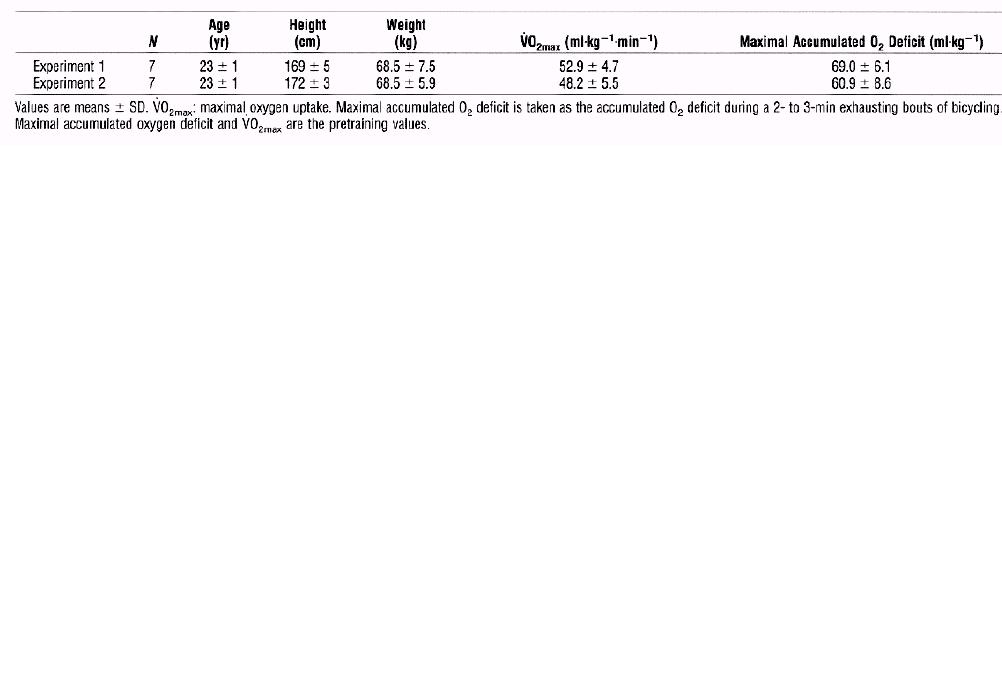
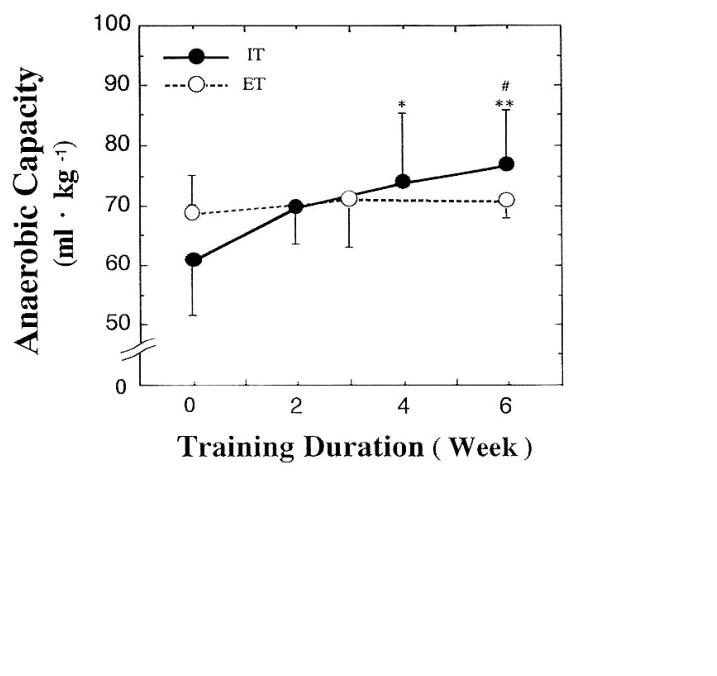
And this is why the Tabata Protocol in the paper increased VO₂.  The Tabata group performed 70 minutes a week at LSD and high intensity work.  However there are some other things to consider with the paper.   The students were athletic males but the Tabata group stated with a lower Relative VO₂, therefore if we take into account the ceiling effect of training, with the ET group having a relative VO₂   of 52.9 +/- 4.7 ml·kg·min⁻¹ the amount of improvement could be minimal… if only doing LSD work.

But to look at the figures for VO₂ both groups improved but the Tabata Group (IT) had more room for improvement and they trained both LSD and high intensity.  And yes, anaerobic capacity did not improve in the ET group, but that would be expected with the type of training performed.

Let me make this clear.  I’m not against interval or intensity training.  High-intensity interval training and the Tabata protocol are only one tool in the toolbox.  Claiming that intervals can increase VO₂ and anaerobic capacity, when the protocol is incorrect is false advertising.  8 sets of 20 sec on and 10 sec off may be challenging but the Tabata protocol it is not since body-weight stuff or the other stuff that is often suggested simply cannot achieve the workload of 170% VO₂ max that this study used.  Use the “Tabata Protcols” for what they are… a hell of a workout, but if you are looking to increase VO₂ and anaerobic capacity using the true Tabata Protocol, I suggest getting some bike shams, because you are in for some long hours on the cycle trainer.


Once again, yours in Health and Performance,

Jeff Osadec, MKin, CEP, CSCS



The Basis of Modern Training Process

As many of you                have already figured out, I am a huge proponent of education both academic and professional upgrading.  I am very fond of the integration of the pure science and the holistic approaches, however in the past I have not provided enough evidence based articles to back up the claims that I have learned through some of the course work I have attended.  From now on I will aim to do just that, however the frequency of my posts may decrease as I aim to research the topics to a greater degree.

Another thing I am a total geek for is reading.  Funny, I hated it as a kid, and read only when I needed to complete a book report.  Magazines were more my thing, less time, and more than one long article.  However my love for reading came in University when I started to read what I was interested in, and peaked with the meeting of Andrew Gustafson.  I to this day admire the depth of Andrew’s knowledge and wide array of reading material.  When I worked with Andrew, I would go into his office and see what new books he had in his library.  Each week I went to work, my wife Pam was hoping that Andrew did not get any new books because she knew that the shift I worked would be spend at Chapters ordering new material.

I have just started a new book called “The Secrets of Soviet Strength Training by Dr. Michael Yessies.  The Secrets of Soviet Sports Fitness and Training, published in 1987, tells the story of Soviet sports success in the Olympic Games and World championships.  It describes the key factors of the Soviet system of training athletes — a system that is still unsurpassed by any country in the world — not even after the country was dismantled.  I purchased an updated version of the text.  In addition to the original, an addendum has been added to each chapter to bring it up to date with the advances that have been made since the first printing.  More information from practicing Russian coaches as well as from the literature has been included.  Also added are results from application of Russian methods by coaches who have incorporated one or more aspects of their system.

Reading the text, coupled with a conversation with a client and the fact that her son at 8years old plated 6 games in 7 nights though got me thinking back to an article that I read and summarized in graduate school.  It was called “The Basis of Modern Training Process Periodization in High Performance Athletes for Year Preparation” by Vladimir Platonov.  This article summarized the training a periodization of athletics, and our job in school was to summarize the “directions” into one or two sentences.   Although this is directed at national and professional athletes there is a great amount we can learn from this and translate to the training and periodization for youth and recreational athletes/ weekend warriors.

Below are the summarized directions that may help you as you read the article.

Platonov-2006-

Direction 1

The volume of training has increased 2 – 4 times since the 1960’ mainly due to the increase in commercial competitions.  This increase in training volumes had a negative impact on the success of the individuals and/ or teams performance.

Direction 2

Early specialization of children for the hopes of producing the elite athletes has been detrimental to long term athlete development.

Direction 3

The number of competitions in a given year has risen which does not allow the athlete to peak at the major competition.  They must perform at each competition to obtain points for standings.  This may decrease the perceived “importance” of the main competition (e.g. Olympics)

Direction 4

Periodization of the training for an athlete must be set in such a way that it accounts for the athlete at the final stages of their career.  This must include proper rest and health practices. Too long are athletes left “broken” at the end of a career. I will admit, I will try and train my final year veterans at the college for life after their given sport.

Direction 5

Early specialization has lead to a decrease in the general training that develops the structural tolerance of young athletes that improves their capabilities at later stages in their career.

Direction 6

Early specialization has changed the methods in which athletes are chosen for competitive teams/ events therefore changing the direction in which coaches have trained the athletes in the past.

Direction 7

The functional training for an athlete should be foreground to specialized training to ensure proper long term athlete development.   However, my definition of functional is “It is the development of adaptive responses to an endurance or resistance stimulus and the ability to translate those responses in a physical response so that the body can move in synergy and produce a purposeful movement.”

Direction 8

The lack of fundamental training that is compromised for specialized training leads to an over reaching or fatigue response. Athletes are training too hard and too often to recover.  I am going to point a finger at the constant high intensity training that is far too common in the profession today.

Direction 9

Training must be periodized in such a way that it balances the work to rest ratio.  Training must include…

Mobility and Movement Preparation, Pre-habilitation/Corrective Exercise, Elasticity, Core Training, Strength Training, Metabolic Training and Regeneration

Direction 10

Planning and scheduling of competitions must be in a timely and logical order to ensure performance is peak and necessary adaptations take place prior to the event.

Direction 11

The coach/ physiologist must have a large “tool box” from which they can plan appropriate training.

Direction 12

Education and planning of proper progressions, fundamental movement patterns and regenerative techniques for the athlete is highly important in the prevention of injuries.

Direction 13

The methods of training and periodization for athletes of any age must be flexible as to be tailored to the needs of the athlete.  Planning and periodization is not a ridged method.


The article by Platonov did a fantastic job of bringing to light some of the glaring issues that occur in many programs that are written for clients, athlete and the general public.  Hopefully, this for a more careful view of your program to ensure that you are not falling into the directions pointed out in the article.  I am now going to spend a bit of time researching some concurrent training articles, looking at the purpose of combining strength training and endurance training, as I believe that the perceived purpose of strength training for endurance athletes is not well understood.

Cheer and once again, your’s in Health and Performance,

Jeff Osadec, MKin CEP CSCS


And the Experiment is Under Way.

I hope those of you who have had the chance to make the coconut breakfast bars enjoyed them.  If I have any other great recipe moments I will be sure to share.

As I mentioned in a previous blog, I was about to start a 7 month experiment with myself as the guinea pig.  And it was funny it was starting at this time.  A few weeks ago I was back at home in Manitoba for my best friend’s wedding.  Now a wedding back at home means all the old gang will be there and the food and booze should be top notch.  Not just at the wedding but at each house you visit as well.  You have to understand that I am Ukrainian.  That means for every occasion we eat.  Wedding, we eat.  Funeral, we eat.  Baby born, we eat.  The sky is blue, we eat.  You get the picture.  Now I am going to say the food is amazing but not necessarily the healthiest of options.  Fried foods, butter, tones of processed carbs are abundant.  But damn does the food taste good, mostly due to the fact that it is comfort food.  So I can tell you I would be eating much differently.

Then I run into my old high school friends.  These are the friends you rarely talk to and you meet up and it is like you have not missed a beat.  These are the friend you have for life and I love every one of them.  I would fight Chuck Norris for any of them.  But something was asked that I had to laugh.  One of my buddies asked, “You heard of this P90X?” to which I replied, “yes.”  He goes, “That shit is hard, like it kicked my ass.  I had to fall to the toilet seat.”  I had a good laugh because you need the visual of seeing him demonstrate how he would sit on the toilet.  But I was proud of him.  This was a guy who did not work out and now, he is.  I had my other best friend drop something in the range of 30 lbs.  I and so proud that they are making these changes.  I got home from Manitoba, spending a week eating food I never eat at home in Calgary, and depleting the stock of Captain Morgan’s Rum in Manitoba, and I felt like crap.  I spent a week detoxing that all out of my body. And that lead me to get excited about my upcoming journey.

So last week I had the chance to strength test myself using a few toys we have at my disposal.  I have about 54 lbs to gain on my squat, 47 lbs to gain on my Deadlift and 55 to gain on my bench.  No small feat.  The movement assessment we perform at work, I failed miserably.  But hey, I have to start somewhere.  And no I know.  I still have to do the VO₂ max test but that will be in November when the running starts as well.  But looking at all of this I though back the question, “You heard of this P90X?”  Really I wouldn’t piss in Tony Horton’s (developer of P90X) ear if his brain was on fire.  Not because I hate the guy.  I am jealous to some extent that he takes a canned program, based on the simplest of training principles, lays out the program and sells it for a boat load of cash.  He probably sleeps on a pile of money.  I write programs day in and day out.  I just don’t get my product out to the masses, solely on principle of not selling out   By selling out I mean, most of these internet trainers just write all these programs, sell them and actually never train anyone.  And don’t get me wrong, I am not saying that Tony Horton isn’t a trainer, I am just pointing out a trend.  But really it is that easy.  This P90X is a program, based on simple training principles of periodization, progressive overload etc.  He pairs that up with a sound nutritional plan and there you have it.  People are making gains, loosing body fat, and/ or increasing muscle.  Who would have thought?  That is just it.  It does not have to be hard; you don’t have to shell out a bunch of cash for “P90X”.  You have to take a simple program of weights and cardiovascular exercise and stick to it.  Pair that up with eating well, and you have the recipe for success.  There are no magic pills or procedures.  It is just a simple process of setting a goal, and seeing it through.

Yours in Health and Performance,

The Importance of the Basics… again.

I am still writing from beautiful (although today rainy) Park City, Utah.  And with the need for increased recover between workouts for the athletes, I have had time to catch up on reading articles and well, writing a couple of blog posts.

I read an article last night looking at our ability to recover from the everyday stresses of life, and for some exercise.  We have to understand that every day we are exposed to stressors; physical, chemical, electromagnetic, psychological, nutritional, and thermal.  Yet, we say we are doing everything correctly and do not yield any results from our efforts.  It was stated by Paul Chek, “How can it be that we put men on the moon at will, make laser guided missiles, have the ability to image your insides with incredible reproducibility and perform major surgery through a key hole, and yet last year alone, American pharmacies filled three billion prescriptions?”  Because we screw up the little things, that’s why.  We go to bed late, our training is poorly periodized, and we eat shit and then expect to perform optimally.  It doesn’t work that way.  We need to build the foundation around us so that we can handle the stressors we are exposed to.

I should jump back and explain what I mean by the stressors.  Physical – this could be in the form of an injury but in most cases, it refers to exercise, be it intensity, weights or long slow distance cardio.  Chemical stressors we are exposed to everyday.  Yes we produce chemicals within the body that cause stress however that is part of the adaptation process.  It is when that ability to respond is decreased we end up with issues.  As well, within the body we have parasitic organisms that produce chemicals that could be considered a stressor, but it has been shown without the parasitic organisms, we would have a compromised immune response.  Electromagnetic is something we are exposed to everyday.  Blame the computers, the cell phones, the ipods and the big screen televisions.  And most of these are present in the bedroom, which screws with the sleep patterns leading to psychological stress.  I alluded to the disturbance of sleep patterns in a previous blog post http://deliberateperformance.ca/2010/06/20/the-importance-of-sleep/) so I will not bore you again with the details.  But psychological stress is not just a disturbance in sleep.  It can be the constant chatter that is present in our heads every day, the noise that can cause paranoia and self doubt.  Nutritional, well once again we can start back at (http://deliberateperformance.ca/2010/07/07/the-simple-nutritional-approach-part-1/) and continue through parts 2 and 3.  Thermal really comes down to the body’s ability to adapt to the varying temperature that we may be exposed to in our respective climates.  This tends to be less of a problem as most of us have the ability to dress accordingly to the weather we are about to encounter.

So why do I write this?  Well it hit me at the camp here at Park City.  We are pushing these athletes to the edge, in order to get a desired response.  However in the process, we expose these athletes to physical (workouts), chemical (body’s response to intensity such as an increase in lactate and the altitude of Park City, Utah), and psychological (the stress of performing twice a day).  Electromagnetic is pretty easily controlled.  All the athletes are conscious to the effects of televisions, cell phones and computers have on sleep so they take the necessary steps to eliminate them.  Nutritional is well controlled, as the evening meal is prepared but a chef who is also a triathlete, so I am going to say that the correct balances of carbs, proteins and fats are there.  Is it organic… let’s pretend that it is.  I can tell you that I hit a Whole Foods, and my room is stocked with only organic, as is much of the athletes rooms.  Thermal, well, they are well prepared for that.

Now it is the responsibility of the coaching staff to monitor, and make sure that we are cognisant of the program and planning in recovery for the athletes to combat the physical, chemical and psychological.  Now I need to stress that you do not need to be an elite athlete, or have a team of coaches, physiologists, and therapists in order to manage these stressors.  You need to be aware of these stressors (physical, chemical, electromagnetic, psychological, nutritional and thermal) by understanding them, respecting them and taking care of the basics.  Remember those basics are… high quality foods, clean water and adequate sleep.  Take care of those three first and the rest can to some degree manage themselves.   It’s really not that hard for most people.  It is when you get to the elite level you need to take into consideration a few more extenuating factors.

Just a little thought in my head this rainy afternoon.

Yours in Heath and Performance,

I Am My Own Biggest Experiment.

I am proud to say that I am writing this while on the road with the Canadian National Cross Country Ski Team.  I say this with great prides and a sense of accomplishment.  When I moved from Winnipeg to Calgary, it was with the intent to work with a Canadian National team.  Well, here I am.  Now I will admit that I am the assistant strength coach and my role is minor, I am extremely proud of accomplishing a long awaited goal.

But today I have been busy programming, not for any one I train, but for myself.  As some of you may or may not know, I have entered the Calgary Subaru Half Marathon on May 29th, 2010.  Not I am going to be totally honest, I HATE RUNNING.  I was once heard saying, “Why run, why train your heart?  You cannot see it.”  I used to live by the motto “why run when you could walk, why walk when you could crawl, and why crawl when you could just lie there!”  But I believe that we need to work on what we are most weak at.  And cardio is my weakness.

Now the truth is I was bored.  I needed to train for something, but I work in a gym that trains power lifters and Olympic lifters.  But really, that is not something I want to compete in.  Crossfit?  Not really for me at this time in my training.  Last time I followed Crossfit, I buggered my elbow to the point I am just starting to flex it pain free.  I know life is an anaerobic event.  Everything we did as cavemen was anaerobic in nature… running from a Sabre-toothed tiger, throwing a spear etc.  But there is massive need for aerobic fitness.  From a perspective of training we need to have adequate fitness in both aerobic and anaerobic fitness.  The following diagram was one that I used in my Masters defence.

This above diagram is based on a hydraulic model demonstrating that the ability of the aerobic system plays a major role in the ability of the anaerobic system.   When someone does an anaerobic event or act, the capacity of the anaerobic system decreases.  If this was animated the water in the “Ana Capacity” would go down.  In that case the water from the “Aerobic Capacity” would thus travel through the tube and replenish the “Ana Capacity”.  So it is the responsibility of the aerobic system to replenishing the energy of the anaerobic reservoir.  Now, I cannot say that all my workouts are anaerobic in nature, but I prefer them over the long slow distance.  I like strength training, deadlifting and attempting to squat heavy.  I will admit that I have in the last few years let my Aerobic fitness decline to levels I am frankly embarrassed about.

Now on the strength side, there is studies that state that strength declines after the age of 25.  I would argue this as I have become much stronger in the past two years than I was when I was 25. I would attribute that to much smarter training and a more systematic approach to periodization.  This is when the thought of the “the experiment” began.   I know the last time I ran, I was down to about 145 lbs.  I was terribly skinny.  And everyone thinks that is what a runner is supposed to look like.  But being here in Park City, I look at the team of athletes.  They are some of the most aerobically fit individuals I have met in my entire life.  What they do for a warm up would crush most people… and they are doing this at altitude.  So the question I am going to answer in this next period of my training is what will happen if I take a rather unique approach to training, incorporating the aspects of training for the big deadlift, bench and squat, while addressing the little issues I have in terms of functional asymmetries all the while aiming to complete this half marathon in a respectable time.   Really, at the age of 32, can I be fitter and stronger (and look better naked) than I ever have.  This next year should be rather interesting.

Stay tuned as testing begins on the 14th of October.

Yours in Health and Performance.